Modern Islamic education faces a great challenge in integrating revelation and reason. Amid the dominance of the secular paradigm in the global education system, there emerges an urgency to restore the function of knowledge as a means of drawing closer to God, not merely as a tool for producing or consuming value-free knowledge.
History records that Muslims were once pioneers in various branches of science. The golden age of Islamic civilization was marked by the emergence of great scholars who developed science without abandoning its spiritual dimension. Knowledge was understood as part of worship and a means to comprehend the signs of God's power.
However, in the contemporary education system, many Muslim students experience alienation from knowledge because they consider it to originate from the West. This view gives rise to a crisis of self-confidence and weakens the spirit of seeking knowledge. In fact, many theories and methods in modern science have roots in classical Islamic civilization.
Modern knowledge tends to be secular and claims value neutrality. Knowledge is considered valid if it can be tested empirically and rationally, without connection to morality or spirituality. This approach overlooks the divine dimension in the process of seeking knowledge, resulting in individuals who are intellectually intelligent but spiritually poor.
In this context, there arises a need to develop an educational paradigm that not only emphasizes cognitive aspects but also revitalizes the relationship between knowledge and revelation. Islamic education is expected to be able to harmonize the function of reason as a tool for thinking and revelation as the source of absolute truth.
Islamization of knowledge does not mean attaching Qur'anic verses to Western theories. Islamization requires the reform of the thinking paradigm and the reconstruction of epistemology, namely reorganizing the foundations of how knowledge is acquired and understood. This includes fundamental questions, such as what is the nature of knowledge? Where does it come from? What is its purpose? What is its impact on human life and the hereafter?
This reconstruction requires an integrative approach that places revelation as the highest source of truth and reason as a tool to understand God's creation. Within this framework, knowledge is no longer neutral but bound by Islamic values that emphasize justice, balance, and responsibility.
Islamic educational institutions have a strategic role in shaping the scientific identity of the Muslim generation. Through an integrative curriculum, students can be introduced to Muslim scholars such as Al-Khwarizmi, Ibn Sina, Al-Farabi, and others who are concrete examples of the synergy between faith and knowledge.
Science and technology education in Islamic schools need to be designed not merely to transfer knowledge, but also to cultivate spiritual awareness. For example, when students learn about the law of gravity, teachers can relate it to the orderliness of the universe, which is a sign of God's power. The learning process becomes a means of tazkiyah (self-purification), not just mastery of the material.
Critical thinking skills are very important in the educational process. However, critical thinking in the Islamic perspective does not mean freeing oneself from values, but rather daring to ask questions based on ethics and the guidance of revelation. Islamic education must be able to encourage students to be analytical toward information, while still maintaining proper manners and faith.
Students are not only trained to memorize and repeat information, but are also invited to reflect, analyze, and evaluate knowledge with a holistic approach. In this way, they can grow as individuals who are intelligent, wise, and morally and spiritually responsible.
In Islam, knowledge is not merely a tool to obtain a job or achieve social status. Knowledge is a path to God. The Prophet Muhammad SAW described those who seek knowledge as people whose path to paradise is made easy. Therefore, Islamic education must not lose its spiritual orientation.
Knowledge should lead humans to recognition of the greatness of Allah and encourage them to do good on earth. Successful education is education that is able to produce individuals who are not only smart but also virtuous and have a high awareness of God.
Islamic education today and in the future must return to its paradigmatic roots based on monotheism. The integration of revelation and reason is not only ideal but a necessity to build a civilization that is just and progressive. With this awareness, knowledge will once again regain its dignity as a light that guides humans toward happiness in this world and the hereafter.
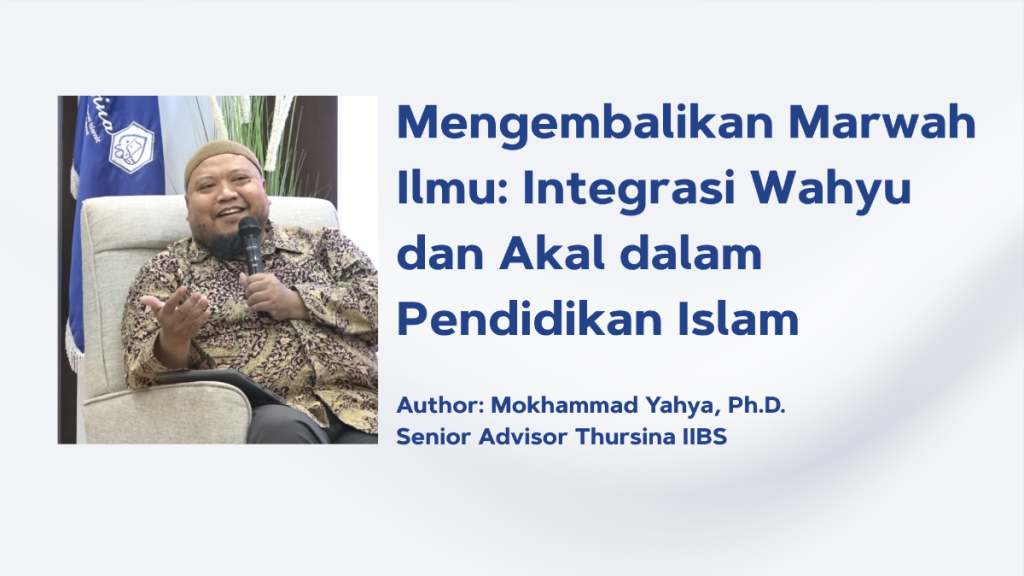
By: Ustadz Mokhammad Yahya, Ph.D. (Senior Advisor of Thursina IIBS)