Indonesia is one of the countries with a very large number of Islamic-based educational institutions, both under the auspices of Nahdlatul Ulama, Muhammadiyah, and other organizations. The great vision of these institutions is to build an advanced Islamic civilization, based on the values of revelation and the example of the Prophet Muhammad. This spirit is reflected in Surah At-Taubah verse 100, which narrates the struggle of the Muhajirin and Ansar and the promise of paradise for those who believe and obey Allah SWT.
In the context of educational and organizational leadership development, the Manhaj Rabbani approach is very important. Manhaj Rabbani is a methodology of life that relies entirely on the guidance of Allah and His Messenger. This approach emphasizes the need for tajdid (renewal) and islah (reform) that is comprehensive in the fields of education, social, and economic aspects, so that it can produce an integrated, comprehensive (syumul), and sustainable system.
In order not to stop at transactional relationships, this system needs to be designed to be stable, effective, strong, impactful, efficient, and capable of directing spiritual and social achievements through the following principles:
Mardhatillah (the pleasure of Allah): a comprehensive and sustainable system.
Barakah / Mubarakah (blessing): relevant and continuously adaptable.
Al-Falah (success in this world and the hereafter): balanced and comprehensive.
‘Afiyah / Sa’adah / Inayah / Khasyah (well-being and happiness): integrative and harmonious.
Rahmatan lil ‘Alamin (mercy for the universe): a holistic and universal system.
From that foundation, the concept of IHES (Integrated Holistic Education System) was born as a model for implementing the Manhaj Rabbani in the field of education. IHES is an integrated and holistic education system, combining all aspects of life—spiritual, intellectual, emotional, social, and physical—within a single framework for the development of a complete human being.
Three Pillars of IHES: Hardware, Software, and Heart-ware
IHES consists of three main pillars:
Hardware: Physical structure, policies, and educational institutional systems.
Software: Curriculum, learning models, educational technology, and governance.
Heart-ware: Values, morals, spirituality, and the heart as the center of awareness. Heart-ware becomes the main core. Transformation in education does not only occur from teacher to student in the form of information, but must touch the heart, as the meaning of the pedagogy of the heart.
This is in accordance with the hadith of the Prophet Muhammad (peace be upon him):
"Know that in the human body there is a lump of flesh. If it is good, then the whole body is good; if it is corrupt, then the whole body is corrupt. Know that it is the heart." (Narrated by Bukhari & Muslim)
Seven Fundamental Elements of IHES
To implement IHES effectively and comprehensively, there are seven interrelated fundamental elements:
- Guiding Principle, which is the basic principle that guides the direction of education.
- Framework, which is the conceptual framework for developing the education system.
- Education Model, which is an integrative and adaptive education model.
- Governance, which includes professional, transparent, and accountable institutional management.
- Components, which are the main components of education, whether formal, informal, or non-formal.
- Total Quality Education Management System (EdMS), which is the total quality management system in education.
- Implementation Model: the strategy for implementing and sustaining the system.
IHES is not only applicable in formal educational institutions, but also in informal and non-formal institutions supported by the economic system (as a tool of reinforcement) and the environmental system (as a platform or life ecosystem).
Three Main Achievements of IHES:
Through the implementation of IHES, there are three main expected outcomes:
- Balanced Human: Individuals who are able to balance the spiritual, intellectual, emotional, and physical aspects in their lives.
- Holistic Personality: A complete and mature individual, who develops harmoniously in all dimensions of humanity.
- Development of 23 Human Potentials: Enhancement of individual potential covering aspects of faith, intelligence, life skills, creativity, leadership, social sensitivity, and others in an integrated manner.
Towards the Revival of Rabbani Leadership
The development of an IHES-based education system becomes an important foundation in shaping a generation of leaders who possess spiritual integrity, intellectual capacity, and social concern. The revival of leadership cannot be built solely through a secular or transactional system. An educational transformation rooted in the heart and the values of revelation is required.
The Rabbani approach through IHES provides a framework that can awaken the leadership awareness of the community—not only capable of leading organizations but also of leading civilization. With the integration of a solid educational system and deeply rooted rabbani values, we are optimistic that a future generation of leaders will emerge who are not only academically intelligent but also strong spiritually and socially.
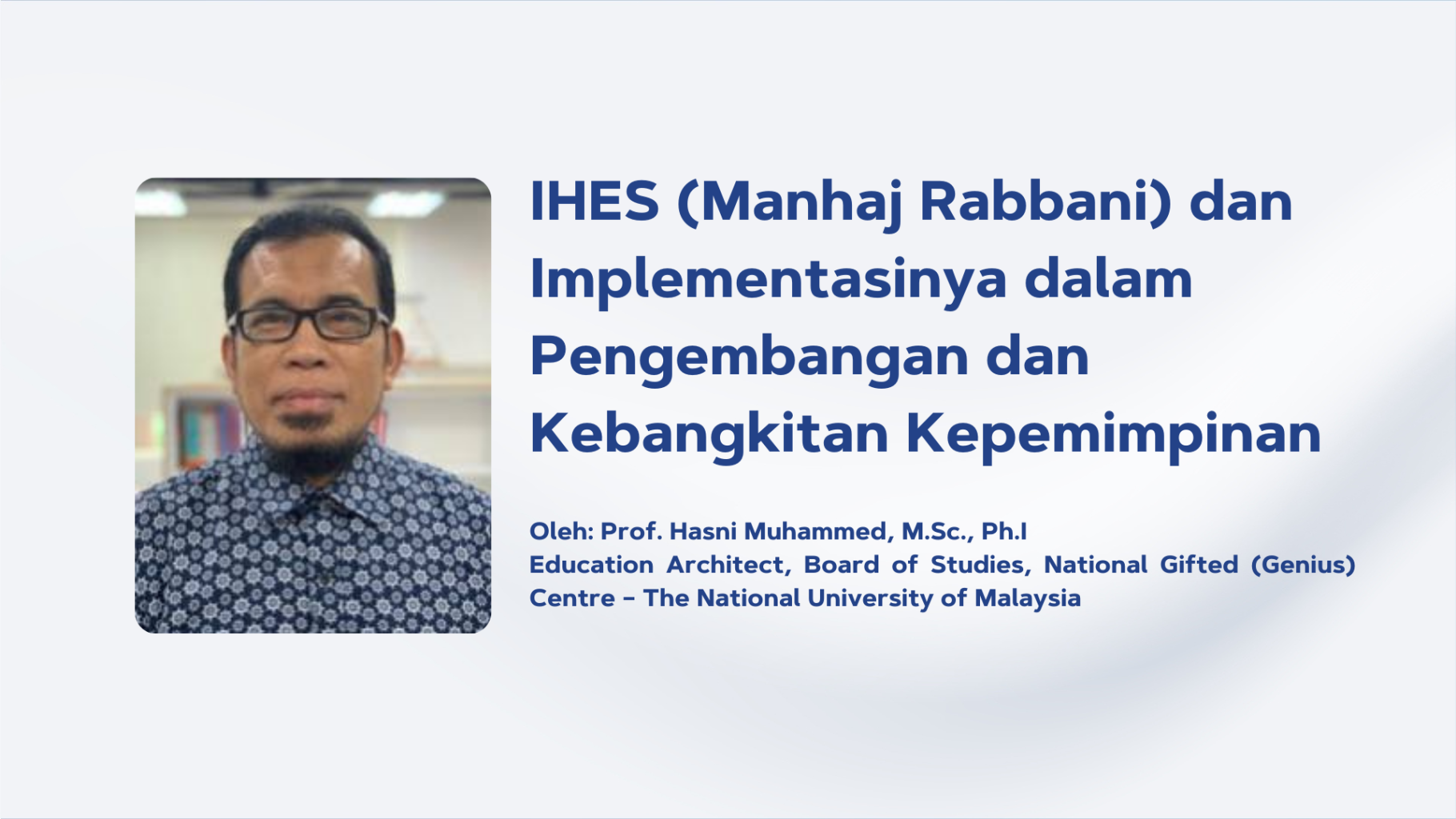
Author: Prof. Hasni Muhammed, M.Sc., Ph.I
(Education Architect, Board of Studies, National Gifted (Genius) Centre – The National University of Malaysia)